Showing posts with label cycling. Show all posts

Monday, 14 July 2014

Resources


This post is about the resources I found most useful when planning my pilgrimage.

Planning the route through southern England 
I used the 1:50,000 OS maps, including the online version available on www.bing.com . Recent editions show long distance cycle routes.
Sustrans.org.uk have an online map of long distance cycle routes. This can be expanded to a very large scale. However, there was no convenient direct route from St Ives to Hertford, and the London-Brighton route headed too far west for me as I wanted to reach Newhaven. So I plotted my own route, using the official cycle routes for only part of the way. The Lea Valley route proved to be very rough for several miles, and was the cause of the problems I had with my pannier bag disintegrating. Signposting on these long distance routes was erratic and confusing.  For example, I lost the route in the Isle of Dogs, at Catford, near the Croydon Tramway, and in New Addington.

Planning the route through France
IGN maps at scale 1:100,000 show all minor roads and contours, and are ideal for planning a route avoiding hills as much as possible. 'Tourisme et Decouverte' series www.ign.fr
At an early stage, I tried the online version http://www.geoportail.gouv.fr/accueil but ended up buying printed copies from Stanfords bookshop in London, which I carried with me on the journey. I used a standard road atlas of France for the macro planning i.e. establishing a direct route between Dieppe and St-Jean-Pied-de-Port broken into days covering approx 60 miles (100km).  I was keen to visit Amboise, final home of Leonardo da Vinci, and also to call in on my cousin near Marmande. Both these places are off the regular pilgrim routes. Having established the ideal stopping points, I sought campsites at these locations using a Google search. In fact, most town and many villages in France have a municipal campsite and it was possible to simply turn up and pitch the tent. The only major place we visited in France which didn’t have a campsite was Mont-de-Marsan.

Planning the route through Spain  
I used the German-language guide Jakobs-Radweg von Pyrenaen nach Santiago de Compostela. 2009. Radingersdorf: Verlag Esterbauer. 978-3-85000-166-3; and   The Way of Saint James : a cyclists guide from Le Puy en Velay to Santiago de Compostela (by John Higginson). 2nd ed. 2005. 978-1-85284-441-7 Milnthorpe: Cicerone. The German guide has details maps of each section of the cycle route through Spain, with a very approximate gradient profile, list of accommodation and other facilities in towns and villages en route, including campsites. But both books were quite old and so some of the information was out of date. Although the Higginson book has the advantage (to me) of being written in English, the maps are less detailed than Jakobs-Radweg. Gradient profiles were better, but still it didn't give enough detail about certain hilly sections of the road. I didn’t try to cycle on the walkers’ path, which is often very rough, and used normal roads instead. 

Another cycle pilgrim showed me the guide book he was using - St Jacobs Fietsroute (by Clemens Sweerma). It’s in Dutch, but the layout and detail looked excellent. The guide is in 3 volumes - Haarlem to Tours, Tours to the Pyrenees, and the Pyrenees to Santiago. Available from Europa Fietsers. I plan to buy a copy out of curiosity.

The Junta de Castilla y Leon publish a series of booklets describing several of the pilgrimage routes into Santiago. I have Route de Santiago: the silver route: a practical guide for pilgrims. This route comes up from the south via Salamanca, so only part of it was relevant to my 2014 journey. The booklets include tables of distances, facilities at towns or villages, photos, websites, what to see, gradient profiles, list of useful addresses. And they are very compact, so don’t add much weight to your pack.

The ‘Maps with me’ app proved handy as it could be enlarged to show local roads and street, marked campsites, shops, and hotels, and functioned independently of a wifi connection. http://mapswith.me/en/home

Before setting out from home, I located campsites by internet searching, and took a printed list of them with me. I did this because I wasn’t sure how reliable internet access would be (it varied). Booking ahead is unnecessary, at least at the time of year I was travelling (May/June), and you need to allow some flexibility to cope with weather conditions, injuries, accidents, and breakdowns. 

I varied from the suggested routes in several places because I found that the main roads were generally quiet, having been bypassed by new motorways.

Confraternity of Saint James. 
The Confraternity is an association of pilgrims and others interested in the Camino. It publishes the Bulletin, a magazine with news, informational and reflective articles, about 4 times a year. The Confraternity will supply members, on request, with a Pilgrim Record which can be used to collect evidence of places visited en route, and presented to the Pilgrim Office in Santiago in order to obtain the 'Compostela' or pilgrim certificate.


Online groups
The Yahoo group santiago_bicicleta was worth joining as it put me in contact with other cyclists who had  made the pilgrimage.


What to take - a friend gave me a copy of her packing list when she cycled the Camino 17 years ago. It gave me some useful hints (e.g. about having some string and wire for emergencies). There are plenty of examples on the internet of what different cyclists have taken with them. My toolkit was the one I carry every day when cycling near home. However, because I had a support team (i.e. Brendan in the car), I didn’t need to carry a tent or sleeping bag or indeed my spare clothes on the bike. On the Camino, I noticed that some cyclists were loaded with a huge amount of stuff. Others were travelling light, either because their belongings were being moved for them by a van or minibus, or because they were staying in hostels, refuges, or hotels.

For an idea about how little it’s possible to travel with, visit the blog of Frank Burns, on http://frankburns.wordpress.com/2014/05/05/the-final-detail/ and you’ll see photos to show what minimal luggage looks like. 

Insurance - I joined CTC and used their insurance scheme. My bike is valued at more than what the household insurance will cover.

Mobile phone and internet access

Mobile phone coverage was excellent throughout rural France and Spain. My internet provider promised free online coverage in France, but this did not materialise. Most campsites, restaurants and bars had wifi access. Just ask.

Saturday, 21 June 2014

Day 25. Palas de Rei to Ribadiso. 35 miles

Day 25. Palas de Rei to Ribadiso. In both directions. 35 miles.

Before I start on today (Saturday 21st), I need to give an update on yesterday evening. While having a pint and seeing to our emails and the blog, we got chatting to a couple from Clonakilty in County Cork. They were cycling from Burgos to Santiago, and like many of the pilgrims we are meeting, using the services of a luggage transfer service i.e. you don't have to carry all your stuff with you on your back or on the bike: it's transported for you between overnight stops.

They were at the next table to us during the evening meal, so the conversation continued. the meal itself was excellent. No menu, you had to take what was served. Started with homemade soup (chicken stock, white beans, potatoes and turnip tops), followed by a huge platter of casseroled pork ribs, with chips and an enormous salad. A litre of chilled (!) red wine came with the meal. And for dessert there was a choice. I had pineapple cake and Brendan had local cheese with quince jelly. Neither of us took coffee but enjoyed the free glass of grappa. All the veg, the wine and the grappa were from the campsite's garden and vineyard. Probably the quinces too. So this is a restaurant to recommend. Camping Santa Marina, Portomarin. I'll add a link later.
We slept well last night.

A slightly complicated day. Brendan set off on foot from Portomarin to walk to Palas de Rei. I struck camp (such a quaint expression!) then drove to Arzua where I'd found some information on the internet that there might be a campsite behind a hotel. The tourist office told me that it was possible to camp a few kilometres back at Ribadiso. This was hard to find, but there are two albergues in this hamlet. We are camped at one of them with use of the facilities for €5 per person per night.

I cycled from Ribadiso to Palas de Rei and back getting caught in a thunder storm on the way back. But some good came of it. I stopped in a wayside cafe for a cup of coffee, and got a stamp for my Pilgrim Record.

It was dry when I got back to Ribadiso, so I pitched the the tent, then set off to collect Brendan from near Palas de Rei. We stopped in Melide for some food shopping.

Pouring with rain again when we got back to the tent, so headed across the road for a pint and a piece of pie while waiting for the rain to stop.

No wifi where we got our pie and pint, so spent a while writing up my blog post. I'll add it to the blog next time I can get wifi access.
Next task is to unpack everything and check out what the facilities are. The turned out to be excellent, with comfy sitting areas, showers, clean toilets with toilet paper provided. There is wifi at Albergue Los Caminantes where we are camped.

This is probably our most authentic Camino experience so far.
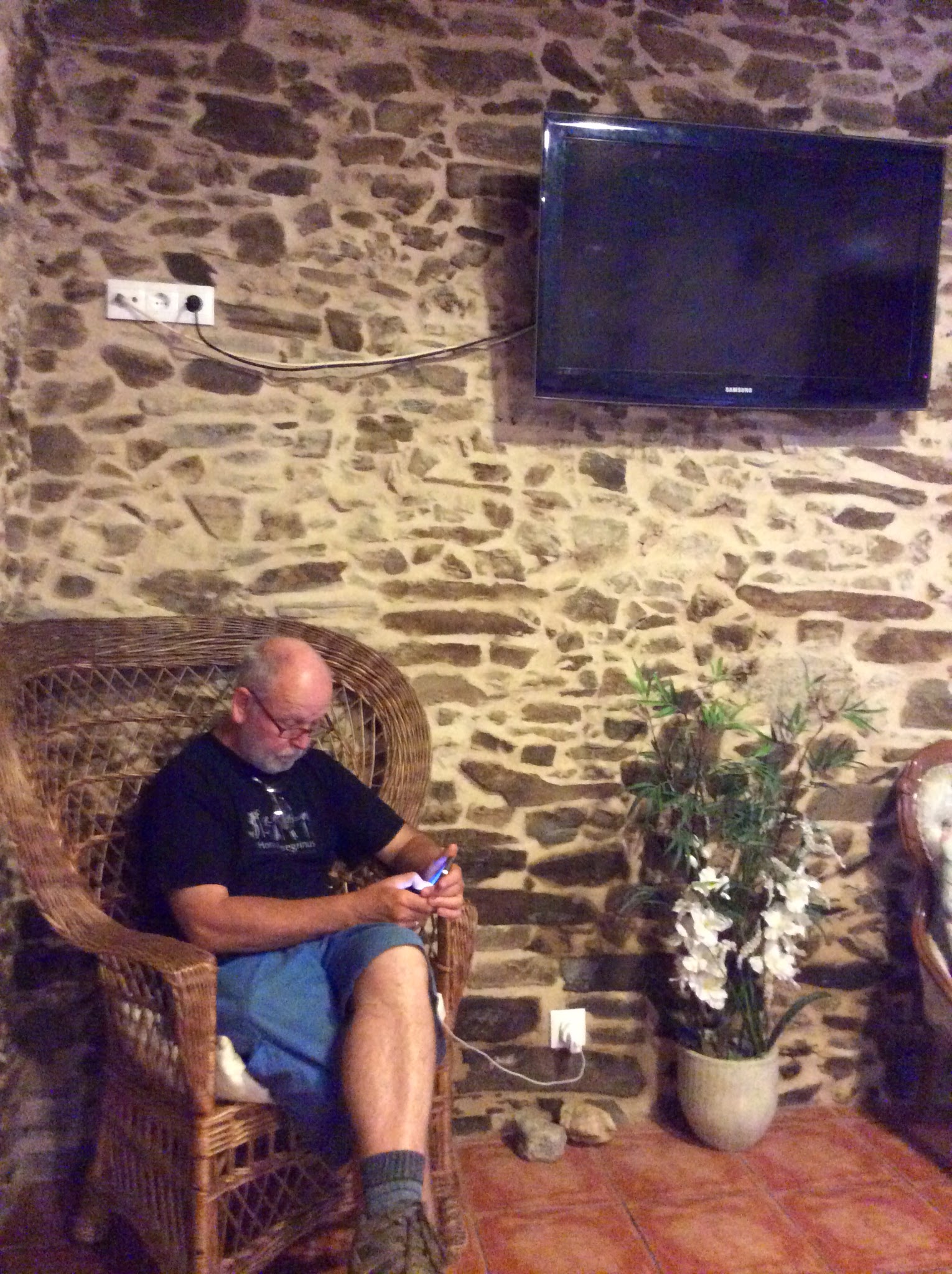
Here is a shot of Brendan sitting in the Albergue charging up his iPhone and checking his emails. A well deserved rest as he walked 25.5km today.


Wednesday, 18 June 2014

Day 22. Rabanal del Camino to Valle do Seo. 44 miles


After a simple but delicious breakfast at the inn, I was faced with a stiff climb up to the highest point on the whole journey, at over 1400 metres, higher than Ben Nevis. Fortunately it was a very cool morning, which helped. The vegetation became greener as the top of the hill approached. Oak is the main tree, with some pine higher up. Two kinds of heather (calluna and erica) and two kinds of broom (yellow flowered large broom and white flowered smaller broom) form most of the shrub layer. There are occasional wild roses, plenty of bracken and, several smaller flowering plants whose names I don't know. Should have brought a flower book.
Anyone know what this little yellow flower is?


Reaching the Cruz de Ferra proved to be a very emotional experience for me. As soon as I saw it looming over the horizon on the last stretch of the climb, tears came to my eyes.It's an iron cross atop a tall wooden pole supported by an enormous, cairn of stones. There are photos of people, and items such as ribbons, flags, and pieces of cloth pinned to the pole. There is a tradition that here pilgrims place a stone from their home country. For some this may symbolise the laying down of burdens, psychological or spiritual, as a part of the pilgrimage. To me, this place seemed to have a far greater sense of spirituality to it than all the churches I have visited so far. I was thinking of the words we use in our church to begin our worship: "Divinity is present everywhere. The whole world is filled with God. But in certain places and at certain times, we feel a specialty of presence..." This was certainly one of those places and times. I felt exhilarated to have reached this high place, but am conscious that another mountain range had to be crossed tomorrow, with an even longer climb. The stone I laid was taken from the river Liddel at my home town, Newcastleton, in the south of Scotland. Brendan too laid a stone from Scotland on the cairn. We spent a while quietly before messaging our families. B gave me a scallop shell to attach to my bike as a souvenir of the journey.

Downhills can be exhilarating. But this one was scary. Long and steep, with a rough surface and many bends. I hoped the brakes would work. Half way down is a tiny village called El Acebo. I had read that cyclists have died here due to slipping on the paved surface of the road. In fact, the concrete paving has rough stones set into it, so it's a bit uncomfortable to ride through. There was a smooth concrete shallow drain down the centre of the road, with water running in it. But I managed.

Our planned meet up in the next big town, Ponferrada, proved a challenge. The place turned out to be vast, a city of maybe 100,000 or more. But thanks to mobile phone technology we found each other. B unfortunately had a minor tussle with a door in a supermarket. He had been attended to kindly by one of the shop ladies and emerged with a plaster on his nose.

Second stop was in the charming town of Villafranca del Bierzo, in the foothills of the next mountain range. Exit from the town took me through a road tunnel by which the N-IV road traffic could avoid the town centre. That road has now been bypassed by a motorway which runs up the valley on a series of viaducts. Many hillsides have been scarred by construction of this road, and although there is some evidence of landscaping/tree planting, it will be many years before the vast scars turn green, if they ever will. The other hillsides of this valley are covered in lush woodland (oak, with pine higher up).

A gently rising, quite road led me to the camping site at Valle do Seo. A quiet meadow surrounded by trees and with the best soil of any camping site so far.


Tuesday, 17 June 2014

Day 21. Part 2. Rabanal del Camino

Rabanal is an old stone village high up in the mountains, something like 1150 metres above the sea. The village looks like a collection of farms grouped together. But every building seems to be in good repair, and there are some that look new.
We booked into the Hosteria del Refugio, which is a village inn.
They do meals and there is a bar.
Here are a few photos of the village to give a flavour.


Day 21. Leon to Rabanal del Camino.49 miles

Day 21. Leon to Rabanal del Camino. 49 miles.

The last day of flat terrain. I think. Leaving the campsite about 9am, I headed straight through the city of Leon, with a short detour to the cathedral where I got my Pilgrim a Record stamped (at the cathedral museum ticket office, actually). Crossed the river on an ancient stone bridge now pedestrianised. Coming out of the city, I rejoined the N-120 road which led me through some rather dull straggly suburbs, all of which had plenty of cafes, restaurants, hostels and hotels, all with an eye to the pilgrim tourist trade. Plenty of pilgrims on foot. Weather fairly cool this morning, as it has been the last couple of days, so ideal for cycling. I could see the parallel motorway as I moved along the N-120. The motorway had far less traffic than the N-120. The tolls must have something to do with this.

Our 6lb Camping Gaz cylinder is about to run out, and we hadn't managed to identify a stockist, so B called in at a hypermarket and bought a small camping stove plus some gas cylinders. Hope it's a kind that can be bought in the UK.

We met up at Hospital de Orbiga for my early sandwich. This is many charming small town on the Camino taking its name from an early religious foundation for pilgrims. There was a pharmacy nearby, so I bought some cream to help my cracked lip. The pharmacist blamed the sun, which was true, but the crusty bread didn't help. It's a Neutragena product and also has factor 30 sun block in it.

Second stop was at Astorga, a hilltop cathedral city of modest size. On entering the city, I saw the first moving train I'd seen since coming to Spain. There have been very few railway in the area we've been crossing, so railways are few and far between, and probably lowish traffic density. Next the cathedral is a Bishop's Palace, designed by the famous architect, Gaudi. Only €3 to get in. A splendid building if somewhat bizarre, and wholly impractical as a residence for a bishop, and not a patch on his Sagrada Familia church in Barcelona.


The last 20km today took me out into wilder countryside. The road climbed fairly steadily, passing a few very old, stone villages. The landscape changed. No cultivation any more, just miles of scrubby woodland of stunted oaks, some willow, and an undergrowth of some kind of heather. The pine, trees hereabouts seemed to have been planted rather than wild.

Rabanal, when I got there proved to be a substantial village with many places for pilgrims to eat, drink and sleep. There are a couple of food shops too. As the last place before the fierce ascent to the Cruz de Ferro, this looks a prosperous wee place. It would be a ghost town without the pilgrims. We're booked into the Hosteria el Refugio, which is basically a village inn. Going to have a shower, then a walk round the village, then a beer.

Monday, 16 June 2014

Day 20. Carrion to Los Condes to Leon. 63 miles

Day 20. Carrion de Los Condes to Leon. 63 miles.
Yesterday evening we visited one of the many churches in Carrion - Santa Maria del Camino. It has the most spectacular decorated wall above and behind the high altar. It's covered in a huge carved scene showing various saints focused on the Blessed Virgin Mary plus Biblical scenes, and all covered in gold.


All the churches in this town have clocks that chime the hour and the quarters, but they chime a few seconds apart. The nearest first, then a fainter one, and finally a very distant one. I tried to remember how fast sound travels. Would that account for the time lag?
Many church towers round here have storks nests on them. The old convent in a Carrion, has a rickety bell tower held up by steel scaffolding, and several nests.


In one of the tiny villages I passed through today, there was a modern church, with what I guessed must be a purpose built metal tower for them storks. They seemed quite at home.


The strong wind which had made pitching the tent so difficult continued all night. A clear sky, and temperature dropped to 9 degrees by 7am. Note to self - pack an extra blanket next camping trip. We are 900 metres above the sea, so cold nights are perhaps to be expected.
Our first stop today was at Sahagun, a small town with an Irish pub! We had a coffee and cake at a cafe opposite, then B stocked up on groceries at the local Spar.
My route took me under a high speed railway that is under construction. Yet the parallel ordinary two-tracked electrified, line more or less parallel to it seemed to be devoid of trains, at least during the half hour I cycled alongside it. Again the mystery of how Spain can justify construction of these grand pieces of infrastructure.

At Mansillas de las Mulas we stopped next to the parish pump where all the town's old men congregated to set the world to rights. I expect their wives were busy at home, cleaning and cooking while they relaxed.

The Leon campsite is 2 km off the main road up a hill. Small, with tent pitches among the pine trees - so dappled shade - and a very friendly and helpful lady who advised on where we might stock up with camping gaz.


We'll be cooking on the Trangia by tomorrow. Note to self - buy a spare full canister of gaz for the big camping stove. We'll try and cook some potatoes tonight, but if all fails, can get chips at the campsite's cafe. Campsite also has wifi, but it's a bit slow, so not attempting to add photos.


Day 19. Burgos to Carrion de Los Condes. 58 miles

Day 19. Burgos to Carrion de Los Condos. 58 miles.


Navigating through Burgos was straight forward for me on the bike, and would have been for Brendan except that part of the road had been closed by the time he came along, for a marathon. No diversions in place, so he had to try several side roads. This meant that I got to Olmillos de Sadamon, our agreed meeting place before Brendan. A small village with enormous church and a ruined castle. I ate a sandwich here then moved on to Villasandino where we coincided. Lunch was in Melgar de Fernamental, a small town with a charming central square. There were loads of cafés and restaurants, but almost no customers. Maybe because it is Sunday today. Melgar is just off the autovia, so maybe during the week it picks up passing trade.

I was amused, when stopping for a swig of water and an oatcake (yes, there are still some left) to be overtaken by a huge convoy of cyclists, complete with motorbike outriders, cars with full headlights on, ambulance and support van. I seem to be managing with just one support person and vehicle.

By the way, I cycled the whole way along the N-120 road, now dead quiet due to the parallel motorway, which itself was dead quiet.

Near Osorno la Mayor, the Santander to Palencia and Burgos to Leon motorways crossed at right angles, amid a clover leaf of slip roads. The N-120 wove its way through this intersection. But I seemed to be the only person using the road today. The simple fact is that round here there is a very low population. The land is a gently rolling upland plain, probably quite dry in the summer. There are vast fields of wheat wind sunflowers, but hardly any villages, and no isolated farms. At one point I noticed that I could see no houses and or cars. In the far distance to the north are mountains with snow patches still on them.

Weather today was sunny with some cloud giving shade during the morning. Moderate wind from the north east i.e mainly behind me. By mid afternoon, the wind had strengthened and it took both of us to get the tent up, me holding on to the guy ropes while Brendan did the pegging. Normally, the tent can. Be put up by one person.

Good site though.

A cafe in Carrion de los Condes

Wednesday, 11 June 2014

Day 15. St-Jean-Pied-de-Port to Pamplona. 48 miles

Probably the most strenuous day of the whole trip involving an 800 metre climb up to Roncesvalles in the Pyrenees. It was a steady plod up a 1 in 20 gradient and I managed each kilometre in 6 minutes i.e. about 6 mph. With plenty of stops.

Chatted to a couple of other cyclists. A man from the Netherlands who has an electric assisted bike, and because of a heart condition, mustn't let his heartbeat over 120. This was his 7th cycle camino.

Also spoke to a Czech man who was pushing his bike up the hill. I walked with him for about 5 minutes. Fortunately it was quite cool this morning.


After Roncesvalles, the road was mainly downhill, but still a couple of steep uphills to contend with.

Reached the campsite at Escaba just outside Pamplona about 2pm. It was getting too hot for cycling, so after putting the tent up, we had a shower and then a bit of a siesta.

Well, it's what you do in Spain, isn't it?

Monday, 2 June 2014

Day 5. Ezy-sur-Eure to Chateaudun. 79 miles

Day 5. Sunday 1 June. Ezy-sur-Eure to Chateaudun. 79 miles

Today turned out longer than my calculations, but never mind.

Setting off from the campsite, I took the quiet road up the Eure valley, through villages and on an old railway track. I passed a huge aqueduct crossing the valley, I guess taking water to Paris.


Dreux was passed without stopping, but I did notice the Chapel Royal on a hill above the town.

Midday stop at Chartres with its famous cathedral. And in the cathedral, the famous labyrinth. My friend Mike told me recently that the labyrinth is only available to walk on Fridays, which seems a pity as it would be a fine resource for meditation and prayer by pilgrims and visitors. On the other days it is mainly covered by chairs. A few years ago, one of my Edinburgh friend, Fidge, bought a labyrinth canvas, which I sometimes helped with at times when it was in use. I thought about Fidge as she is getting married to Lin today. But lack of wifi prevented me sending a message on Facebook and I didn't have her mobile number.


Chartres is one of the main stops on the pilgrim route from Paris to Compostela, so they are set up to expect pilgrims. However, the man on the cathedral desk seemed a bit grumpy. Well, it must be a bit dull spending all day giving out headphone audio guides to tourists.

Both of us had slight navigational problems finding our way out of Chartres onto a minor road, but we succeeded, and Brendan overtook me a few miles out.

Chateaudun was our stop tonight. A delightful campsite by the river. The manager had just last week received a new stamp with St James's cockle shell on it. I think I was the first pilgrim to get use of the stamp.

Every food shop and supermarket was shut toady, it seemed, so we had a meal made up of odds and ends. But very delicious. No wine, though we walked into town and had a beer.

Chateaudun is a smallish place, maybe 15000 people, and looks a bit down on its luck, despite having a magnificent castle perched on a rocky cliff. It features in Dorothy Dunnett's novel Queen's Play, but I can tell you no more about the plot line. Below the cliff were some troglodyte cave dwellings, now used as storage by the look of it.


Friday, 16 May 2014

Day 2 - Deptford to Brighton via Newhaven (77 miles)

Today's journey was almost identical to yesterday's in mileage, but was much, much hillier. Mapometer calculates that I climbed 4026 feet! Fortunately the climb up to the crest of the north Downs at Titsey Hill (863 feet above sea level) was gradual. The other 3200 feet must have been made up of lots of shorter hills, which, as the day progressed, seemed to become more arduous.

The biggest problem today was the disintegration of my pannier bag. There is a plastic strip that hooks over the metal carrying rack. It is screwed through the canvas. Well, the screws got jolted loose by the rough surface of National Cycle Routes 1 and 22. Fortunately I found a small hardware store (the lady said they were about to shut down - and I could see why - the whole place was a muddle). I bought some string (not much help, in fact) and one of those stretchy things with hooks at either end. A bit later I passed a Halford's (East Grinstead) and bought two more. The rest of the journey saw me with the pannier strapped on top of the luggage rack.

Lesson 1 - Rosemary Hill was right - you need some decent bits of string and wire for unseen emergencies!

Met some friendly people. The shop lady. Then an elderly gentleman (well, older than me) who gave me directions when I wandered off the cycle route in New Addington. He apologised for not having his cycle maps on him! Then the two ladies in the post office/village store at Limpsfield who sold me some lunch and stamped my Pilgrim Record. Outside the shop two passers by chatted about iPads and mobile phones.

Lesson 2 - National Cycle Route signs are a bit hit or miss. Got very confused at Catford, New Addington and some other places. Easier really with OS maps.

At Lewes,  I asked directions of a young women with two children. Her little boy was looking for treasure - apparently indicated by blue crosses painted on manhole covers!

At Newhaven, I went to the ferry terminal, where a rather bemused member of staff stamped my Pilgrim Record. I'll be back in two weeks time when the journey starts in earnest. Spoke to another cyclist en route from Guildford to Paris, who was crossing on the night boat.

A hilly section out of Newhaven, but after about 4 miles, the track came down to sea level, so the final stretch into Brighton was dead easy. A mug of tea and a shower was very welcome.


Stayed with friend Richard, who used to live near St Ives, but moved to Brighton in November. Beautiful top floor flat in a rather grand Victorian terrace.


Quite relieved that I managed two very long days on the trot, with not bad side effects except some slightly sore quads.

Lesson 3 - in view of the pannier problems, I've  thought out a better way of packing - with two panniers insetad. One for things like food and maps I need for that day's journey, the other for emergency stuff and things I might hope not to need until I reach my day's destination.


Tuesday, 13 May 2014

Saint James

Back in 2003 I bought a small figurine of Santiago (St James) which has stood on the mantelpiece ever since. This photo of the Santiago also includes a couple of pebbles from Scotland which I hope to place on the cairn at the Cruz de Ferro, the highest point on the journey.


Sunday, 11 May 2014

Why cycle to Compostela?


I first visited Santiago de Compostela in 2003. Until then I don't think I had even heard of this pilgrimage destination. But as we drove towards Compostela, we got our first glimpse of pilgrims, trudging along the side of the main road. We visited the shrine of St James in the cathedral, then stayed in the cathedral for the mass. They called out the names of pilgrims who had arrived that day, which was very moving.

The idea of completing my own pilgrimage to Compostela grew over time. I discovered that it could be done by bicycle, and started planning to see if it would be possible for me. I found a number of useful websites, but most interesting of all was Frank Burns's blog Serendipities of Life, and especially his Celtic route to Compostela. I joined the Santiago Bicicleta group on Yahoo.

Another good source of information, and inspiration, for me was my colleague Rosemary, who cycle form Cambridgeshire to Compostela with her daughter a few years ago. Rosemary gave me a list of equipment she took, her itinerary (with daily distances) and we talked a lot about the journey.

Initially, I imagined the Brendan and I would both cycle the whole way, but being realistic about the state of Brendan's knees (too much kneeling  for prayer as a youngster?) we decided that I would cycle, and Brendan would be my back-up crew in the car. Brendan decided to walk the final 120km from Sarria to Compostela - assuming, of course, that my knees, and stamina will hold up. If we only make it part of the way, then we'll continue another time.

I reckoned I could do the 2000km in 3 weeks, aiming to cover 100km a day. My recent training runs have been building up to that distance from the 50-60km that up to now has been my normal daily total. Training has taken me round many parts of Cambridgeshire and adjacent counties which I did not know and the longest runs have been to Kimbolton, Saffron Walden, Fotheringhay Castle and Potton.

Some of you may know that when I was 17, my brother David and I cycled from our home in the south of Scotland to Cromer, where our family was having a caravan holiday.  That journey passed through Kings Lynn, so one of my training runs involved me cycling to Waterbeach, catching the train to Kings Lynn, and cycling back from there through the Fens. In this way, I have linked my 2014 pilgrimage into that journey from Scotland 45 years ago.

So why make this pilgrimage? It's partly a physical challenge taken at a point where I was forced into retirement earlier than I had planned. Therefore I now had the time for it (not having to consider annual leave). I suppose it's partly a 'rite of passge' too - about entering a new stage in life where paid work no longer dominates what I do.

Perhaps it was a 'sign' that last Sunday at our church the address was given by one of our young members, Dean Reynolds. Dean has twice walked the pilgrim route to Compostela, starting one time from St Jean Pied de Port and the other time from Leon - on foot. You can read Dean's address here.

I'm not expecting to find the answer to either my problems or the world's problems en route. But I'll take Deans word's to heart: ' there was so much space, times of quiet, times to reflect, no escape from yourself or those around you, forced to confront your body hungry and weary and your mind full of ideas and fantasy'.