Day 25. Palas de Rei to Ribadiso. In both directions. 35 miles.
Before I start on today (Saturday 21st), I need to give an update on yesterday evening. While having a pint and seeing to our emails and the blog, we got chatting to a couple from Clonakilty in County Cork. They were cycling from Burgos to Santiago, and like many of the pilgrims we are meeting, using the services of a luggage transfer service i.e. you don't have to carry all your stuff with you on your back or on the bike: it's transported for you between overnight stops.
They were at the next table to us during the evening meal, so the conversation continued. the meal itself was excellent. No menu, you had to take what was served. Started with homemade soup (chicken stock, white beans, potatoes and turnip tops), followed by a huge platter of casseroled pork ribs, with chips and an enormous salad. A litre of chilled (!) red wine came with the meal. And for dessert there was a choice. I had pineapple cake and Brendan had local cheese with quince jelly. Neither of us took coffee but enjoyed the free glass of grappa. All the veg, the wine and the grappa were from the campsite's garden and vineyard. Probably the quinces too. So this is a restaurant to recommend. Camping Santa Marina, Portomarin. I'll add a link later.
We slept well last night.
A slightly complicated day. Brendan set off on foot from Portomarin to walk to Palas de Rei. I struck camp (such a quaint expression!) then drove to Arzua where I'd found some information on the internet that there might be a campsite behind a hotel. The tourist office told me that it was possible to camp a few kilometres back at Ribadiso. This was hard to find, but there are two albergues in this hamlet. We are camped at one of them with use of the facilities for €5 per person per night.
I cycled from Ribadiso to Palas de Rei and back getting caught in a thunder storm on the way back. But some good came of it. I stopped in a wayside cafe for a cup of coffee, and got a stamp for my Pilgrim Record.
It was dry when I got back to Ribadiso, so I pitched the the tent, then set off to collect Brendan from near Palas de Rei. We stopped in Melide for some food shopping.
Pouring with rain again when we got back to the tent, so headed across the road for a pint and a piece of pie while waiting for the rain to stop.
No wifi where we got our pie and pint, so spent a while writing up my blog post. I'll add it to the blog next time I can get wifi access.
Next task is to unpack everything and check out what the facilities are. The turned out to be excellent, with comfy sitting areas, showers, clean toilets with toilet paper provided. There is wifi at Albergue Los Caminantes where we are camped.
This is probably our most authentic Camino experience so far.
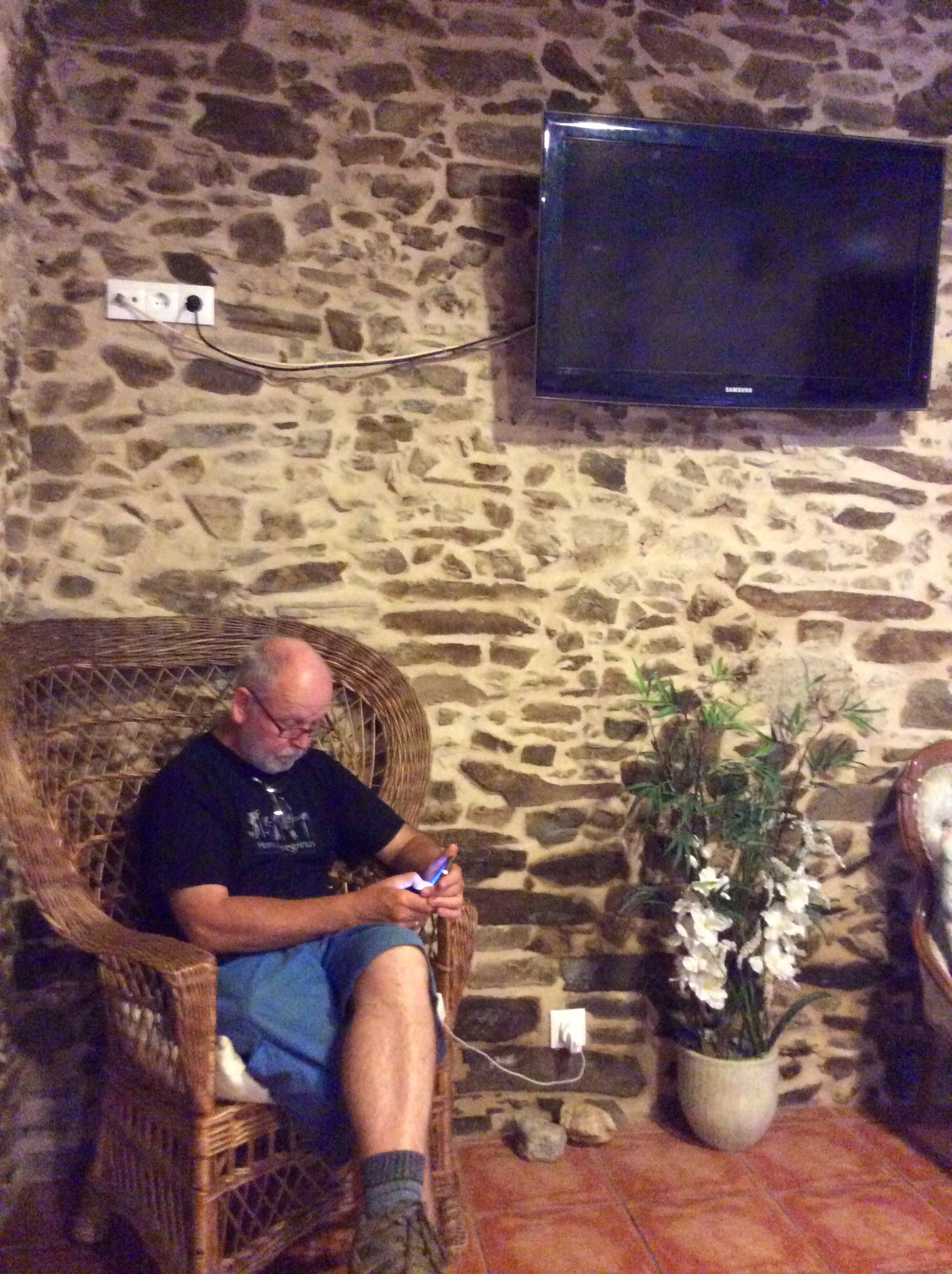
Here is a shot of Brendan sitting in the Albergue charging up his iPhone and checking his emails. A well deserved rest as he walked 25.5km today.
Journal of a pilgrimage from St Ives, Cambridgeshire, to Santiago de Compostela by bicycle.
Showing posts with label Santiago. Show all posts
Saturday, 21 June 2014
Thursday, 19 June 2014
Day 23. Valle do Seo to Portomarin. 60 miles.
Day 23. Valle do Seo to Portomarin. 60miles
After writing yesterday's bulletin, we discovered that the car battery was flat. It's the original battery from 8 year ago. Had it simply come to the end of its life? Recently you we've switched our breakdown cover to Nationwide (it comes with one of their bank accounts), so here was an opportunity to see how it worked. Brendan phoned in the evening to report the problem. It was agreed to phone again in the morning. The engineer arrived within an hour, gave the battery a boost advised be to drive for at least 2 hours today. Great service all round.
So our usual pattern of meeting up during the day didn't happen. B drove straight to the next campsite, at Portomarin, a small town on the shore of what looks like a lake. It's really a dammed up river. The town was rebuilt stone by stone when the valley was flooded. You approach the town over a smart looking bridge, and straight ahead is an enormous flight of steps rising up through a turreted portico into the town. The campsite is off to the right about a mile. Grassy, partly shaded, good facilities, cafe/bar. We're staying here two nights, which will make sense when you read tomorrow's posting.
Back to cycling. It was another cool morning, so the climb up to Pedrafita do Cebreiro proved to be a steady, but not exhausting plod. The gradient averages 4% but there are a few slightly steeper stretches. Fuel was that excellent combination of potatoes (left over mince and tatties from last night's meal, and oatcakes). As time passed, I collected a cloud of house flies - they seemed to like the smell of my sun block (that's being charitable). I didn't shake them off till on the final climb to O Cebreiro. It wasn't that I was cycling faster, quite the opposite, but there was a stiff breeze up that high. O Cebreiro is at 1300 metres. The hamlet includes a cluster of circular, thatched, stone dwellings that used to be summer residences for local farmers when the took their animals up to them summer pastures.
These ones have been restored. The road stayed high up for several miles, undulating a bit, and crossing two more summits, alto de San Roque at 1270m (there is a statue of him by the roadside) and Alto de Poia (1332m).
Just before Alto de Poia I spotted this mountain village graveyard, looking more like a collection of little cabins than graves.
From here the road made a gradual descent for 16 km, with wide sweeping curves and a smooth surface. I got to the foot of this hill (Triacastela) in 25 minutes. The road continues dropping to Sarria, a much bigger town than I was expecting, and not easy to navigate through. The usual white arrows painted on the road as markers to cycle pilgrims seemed to take a break in the town. I saw another cyclist who said he'd come from Santiago and pointed the way for me. His journey started in Lisbon, and he's aiming for France, one of the few pilgrims going the opposite direction. After Sarria, the road climbed for several miles, but, O Joy, the final 8 km were downhill.
Here is the view from inside the tent.
And this is what you see from the terrace of the campsite bar/restaurant. A very fine kitchen garden in th foreground.
After writing yesterday's bulletin, we discovered that the car battery was flat. It's the original battery from 8 year ago. Had it simply come to the end of its life? Recently you we've switched our breakdown cover to Nationwide (it comes with one of their bank accounts), so here was an opportunity to see how it worked. Brendan phoned in the evening to report the problem. It was agreed to phone again in the morning. The engineer arrived within an hour, gave the battery a boost advised be to drive for at least 2 hours today. Great service all round.
So our usual pattern of meeting up during the day didn't happen. B drove straight to the next campsite, at Portomarin, a small town on the shore of what looks like a lake. It's really a dammed up river. The town was rebuilt stone by stone when the valley was flooded. You approach the town over a smart looking bridge, and straight ahead is an enormous flight of steps rising up through a turreted portico into the town. The campsite is off to the right about a mile. Grassy, partly shaded, good facilities, cafe/bar. We're staying here two nights, which will make sense when you read tomorrow's posting.
Back to cycling. It was another cool morning, so the climb up to Pedrafita do Cebreiro proved to be a steady, but not exhausting plod. The gradient averages 4% but there are a few slightly steeper stretches. Fuel was that excellent combination of potatoes (left over mince and tatties from last night's meal, and oatcakes). As time passed, I collected a cloud of house flies - they seemed to like the smell of my sun block (that's being charitable). I didn't shake them off till on the final climb to O Cebreiro. It wasn't that I was cycling faster, quite the opposite, but there was a stiff breeze up that high. O Cebreiro is at 1300 metres. The hamlet includes a cluster of circular, thatched, stone dwellings that used to be summer residences for local farmers when the took their animals up to them summer pastures.
These ones have been restored. The road stayed high up for several miles, undulating a bit, and crossing two more summits, alto de San Roque at 1270m (there is a statue of him by the roadside) and Alto de Poia (1332m).
Just before Alto de Poia I spotted this mountain village graveyard, looking more like a collection of little cabins than graves.
From here the road made a gradual descent for 16 km, with wide sweeping curves and a smooth surface. I got to the foot of this hill (Triacastela) in 25 minutes. The road continues dropping to Sarria, a much bigger town than I was expecting, and not easy to navigate through. The usual white arrows painted on the road as markers to cycle pilgrims seemed to take a break in the town. I saw another cyclist who said he'd come from Santiago and pointed the way for me. His journey started in Lisbon, and he's aiming for France, one of the few pilgrims going the opposite direction. After Sarria, the road climbed for several miles, but, O Joy, the final 8 km were downhill.
Here is the view from inside the tent.
And this is what you see from the terrace of the campsite bar/restaurant. A very fine kitchen garden in th foreground.
Wednesday, 18 June 2014
Day 22. Rabanal del Camino to Valle do Seo. 44 miles
After a simple but delicious breakfast at the inn, I was faced with a stiff climb up to the highest point on the whole journey, at over 1400 metres, higher than Ben Nevis. Fortunately it was a very cool morning, which helped. The vegetation became greener as the top of the hill approached. Oak is the main tree, with some pine higher up. Two kinds of heather (calluna and erica) and two kinds of broom (yellow flowered large broom and white flowered smaller broom) form most of the shrub layer. There are occasional wild roses, plenty of bracken and, several smaller flowering plants whose names I don't know. Should have brought a flower book.
Anyone know what this little yellow flower is?
Reaching the Cruz de Ferra proved to be a very emotional experience for me. As soon as I saw it looming over the horizon on the last stretch of the climb, tears came to my eyes.It's an iron cross atop a tall wooden pole supported by an enormous, cairn of stones. There are photos of people, and items such as ribbons, flags, and pieces of cloth pinned to the pole. There is a tradition that here pilgrims place a stone from their home country. For some this may symbolise the laying down of burdens, psychological or spiritual, as a part of the pilgrimage. To me, this place seemed to have a far greater sense of spirituality to it than all the churches I have visited so far. I was thinking of the words we use in our church to begin our worship: "Divinity is present everywhere. The whole world is filled with God. But in certain places and at certain times, we feel a specialty of presence..." This was certainly one of those places and times. I felt exhilarated to have reached this high place, but am conscious that another mountain range had to be crossed tomorrow, with an even longer climb. The stone I laid was taken from the river Liddel at my home town, Newcastleton, in the south of Scotland. Brendan too laid a stone from Scotland on the cairn. We spent a while quietly before messaging our families. B gave me a scallop shell to attach to my bike as a souvenir of the journey.
Downhills can be exhilarating. But this one was scary. Long and steep, with a rough surface and many bends. I hoped the brakes would work. Half way down is a tiny village called El Acebo. I had read that cyclists have died here due to slipping on the paved surface of the road. In fact, the concrete paving has rough stones set into it, so it's a bit uncomfortable to ride through. There was a smooth concrete shallow drain down the centre of the road, with water running in it. But I managed.
Our planned meet up in the next big town, Ponferrada, proved a challenge. The place turned out to be vast, a city of maybe 100,000 or more. But thanks to mobile phone technology we found each other. B unfortunately had a minor tussle with a door in a supermarket. He had been attended to kindly by one of the shop ladies and emerged with a plaster on his nose.
Second stop was in the charming town of Villafranca del Bierzo, in the foothills of the next mountain range. Exit from the town took me through a road tunnel by which the N-IV road traffic could avoid the town centre. That road has now been bypassed by a motorway which runs up the valley on a series of viaducts. Many hillsides have been scarred by construction of this road, and although there is some evidence of landscaping/tree planting, it will be many years before the vast scars turn green, if they ever will. The other hillsides of this valley are covered in lush woodland (oak, with pine higher up).
A gently rising, quite road led me to the camping site at Valle do Seo. A quiet meadow surrounded by trees and with the best soil of any camping site so far.
Tuesday, 17 June 2014
Day 21. Part 2. Rabanal del Camino
Rabanal is an old stone village high up in the mountains, something like 1150 metres above the sea. The village looks like a collection of farms grouped together. But every building seems to be in good repair, and there are some that look new.
We booked into the Hosteria del Refugio, which is a village inn.
They do meals and there is a bar.
Here are a few photos of the village to give a flavour.
We booked into the Hosteria del Refugio, which is a village inn.
They do meals and there is a bar.
Here are a few photos of the village to give a flavour.
Day 21. Leon to Rabanal del Camino.49 miles
Day 21. Leon to Rabanal del Camino. 49 miles.
The last day of flat terrain. I think. Leaving the campsite about 9am, I headed straight through the city of Leon, with a short detour to the cathedral where I got my Pilgrim a Record stamped (at the cathedral museum ticket office, actually). Crossed the river on an ancient stone bridge now pedestrianised. Coming out of the city, I rejoined the N-120 road which led me through some rather dull straggly suburbs, all of which had plenty of cafes, restaurants, hostels and hotels, all with an eye to the pilgrim tourist trade. Plenty of pilgrims on foot. Weather fairly cool this morning, as it has been the last couple of days, so ideal for cycling. I could see the parallel motorway as I moved along the N-120. The motorway had far less traffic than the N-120. The tolls must have something to do with this.
Our 6lb Camping Gaz cylinder is about to run out, and we hadn't managed to identify a stockist, so B called in at a hypermarket and bought a small camping stove plus some gas cylinders. Hope it's a kind that can be bought in the UK.
We met up at Hospital de Orbiga for my early sandwich. This is many charming small town on the Camino taking its name from an early religious foundation for pilgrims. There was a pharmacy nearby, so I bought some cream to help my cracked lip. The pharmacist blamed the sun, which was true, but the crusty bread didn't help. It's a Neutragena product and also has factor 30 sun block in it.
Second stop was at Astorga, a hilltop cathedral city of modest size. On entering the city, I saw the first moving train I'd seen since coming to Spain. There have been very few railway in the area we've been crossing, so railways are few and far between, and probably lowish traffic density. Next the cathedral is a Bishop's Palace, designed by the famous architect, Gaudi. Only €3 to get in. A splendid building if somewhat bizarre, and wholly impractical as a residence for a bishop, and not a patch on his Sagrada Familia church in Barcelona.
The last 20km today took me out into wilder countryside. The road climbed fairly steadily, passing a few very old, stone villages. The landscape changed. No cultivation any more, just miles of scrubby woodland of stunted oaks, some willow, and an undergrowth of some kind of heather. The pine, trees hereabouts seemed to have been planted rather than wild.
Rabanal, when I got there proved to be a substantial village with many places for pilgrims to eat, drink and sleep. There are a couple of food shops too. As the last place before the fierce ascent to the Cruz de Ferro, this looks a prosperous wee place. It would be a ghost town without the pilgrims. We're booked into the Hosteria el Refugio, which is basically a village inn. Going to have a shower, then a walk round the village, then a beer.
The last day of flat terrain. I think. Leaving the campsite about 9am, I headed straight through the city of Leon, with a short detour to the cathedral where I got my Pilgrim a Record stamped (at the cathedral museum ticket office, actually). Crossed the river on an ancient stone bridge now pedestrianised. Coming out of the city, I rejoined the N-120 road which led me through some rather dull straggly suburbs, all of which had plenty of cafes, restaurants, hostels and hotels, all with an eye to the pilgrim tourist trade. Plenty of pilgrims on foot. Weather fairly cool this morning, as it has been the last couple of days, so ideal for cycling. I could see the parallel motorway as I moved along the N-120. The motorway had far less traffic than the N-120. The tolls must have something to do with this.
Our 6lb Camping Gaz cylinder is about to run out, and we hadn't managed to identify a stockist, so B called in at a hypermarket and bought a small camping stove plus some gas cylinders. Hope it's a kind that can be bought in the UK.
We met up at Hospital de Orbiga for my early sandwich. This is many charming small town on the Camino taking its name from an early religious foundation for pilgrims. There was a pharmacy nearby, so I bought some cream to help my cracked lip. The pharmacist blamed the sun, which was true, but the crusty bread didn't help. It's a Neutragena product and also has factor 30 sun block in it.
Second stop was at Astorga, a hilltop cathedral city of modest size. On entering the city, I saw the first moving train I'd seen since coming to Spain. There have been very few railway in the area we've been crossing, so railways are few and far between, and probably lowish traffic density. Next the cathedral is a Bishop's Palace, designed by the famous architect, Gaudi. Only €3 to get in. A splendid building if somewhat bizarre, and wholly impractical as a residence for a bishop, and not a patch on his Sagrada Familia church in Barcelona.
The last 20km today took me out into wilder countryside. The road climbed fairly steadily, passing a few very old, stone villages. The landscape changed. No cultivation any more, just miles of scrubby woodland of stunted oaks, some willow, and an undergrowth of some kind of heather. The pine, trees hereabouts seemed to have been planted rather than wild.
Rabanal, when I got there proved to be a substantial village with many places for pilgrims to eat, drink and sleep. There are a couple of food shops too. As the last place before the fierce ascent to the Cruz de Ferro, this looks a prosperous wee place. It would be a ghost town without the pilgrims. We're booked into the Hosteria el Refugio, which is basically a village inn. Going to have a shower, then a walk round the village, then a beer.
Monday, 16 June 2014
Day 20. Carrion to Los Condes to Leon. 63 miles
Day 20. Carrion de Los Condes to Leon. 63 miles.
Yesterday evening we visited one of the many churches in Carrion - Santa Maria del Camino. It has the most spectacular decorated wall above and behind the high altar. It's covered in a huge carved scene showing various saints focused on the Blessed Virgin Mary plus Biblical scenes, and all covered in gold.
All the churches in this town have clocks that chime the hour and the quarters, but they chime a few seconds apart. The nearest first, then a fainter one, and finally a very distant one. I tried to remember how fast sound travels. Would that account for the time lag?
Many church towers round here have storks nests on them. The old convent in a Carrion, has a rickety bell tower held up by steel scaffolding, and several nests.
In one of the tiny villages I passed through today, there was a modern church, with what I guessed must be a purpose built metal tower for them storks. They seemed quite at home.
The strong wind which had made pitching the tent so difficult continued all night. A clear sky, and temperature dropped to 9 degrees by 7am. Note to self - pack an extra blanket next camping trip. We are 900 metres above the sea, so cold nights are perhaps to be expected.
Our first stop today was at Sahagun, a small town with an Irish pub! We had a coffee and cake at a cafe opposite, then B stocked up on groceries at the local Spar.
My route took me under a high speed railway that is under construction. Yet the parallel ordinary two-tracked electrified, line more or less parallel to it seemed to be devoid of trains, at least during the half hour I cycled alongside it. Again the mystery of how Spain can justify construction of these grand pieces of infrastructure.
At Mansillas de las Mulas we stopped next to the parish pump where all the town's old men congregated to set the world to rights. I expect their wives were busy at home, cleaning and cooking while they relaxed.
The Leon campsite is 2 km off the main road up a hill. Small, with tent pitches among the pine trees - so dappled shade - and a very friendly and helpful lady who advised on where we might stock up with camping gaz.
We'll be cooking on the Trangia by tomorrow. Note to self - buy a spare full canister of gaz for the big camping stove. We'll try and cook some potatoes tonight, but if all fails, can get chips at the campsite's cafe. Campsite also has wifi, but it's a bit slow, so not attempting to add photos.
Yesterday evening we visited one of the many churches in Carrion - Santa Maria del Camino. It has the most spectacular decorated wall above and behind the high altar. It's covered in a huge carved scene showing various saints focused on the Blessed Virgin Mary plus Biblical scenes, and all covered in gold.
All the churches in this town have clocks that chime the hour and the quarters, but they chime a few seconds apart. The nearest first, then a fainter one, and finally a very distant one. I tried to remember how fast sound travels. Would that account for the time lag?
Many church towers round here have storks nests on them. The old convent in a Carrion, has a rickety bell tower held up by steel scaffolding, and several nests.
In one of the tiny villages I passed through today, there was a modern church, with what I guessed must be a purpose built metal tower for them storks. They seemed quite at home.
The strong wind which had made pitching the tent so difficult continued all night. A clear sky, and temperature dropped to 9 degrees by 7am. Note to self - pack an extra blanket next camping trip. We are 900 metres above the sea, so cold nights are perhaps to be expected.
Our first stop today was at Sahagun, a small town with an Irish pub! We had a coffee and cake at a cafe opposite, then B stocked up on groceries at the local Spar.
My route took me under a high speed railway that is under construction. Yet the parallel ordinary two-tracked electrified, line more or less parallel to it seemed to be devoid of trains, at least during the half hour I cycled alongside it. Again the mystery of how Spain can justify construction of these grand pieces of infrastructure.
At Mansillas de las Mulas we stopped next to the parish pump where all the town's old men congregated to set the world to rights. I expect their wives were busy at home, cleaning and cooking while they relaxed.
We'll be cooking on the Trangia by tomorrow. Note to self - buy a spare full canister of gaz for the big camping stove. We'll try and cook some potatoes tonight, but if all fails, can get chips at the campsite's cafe. Campsite also has wifi, but it's a bit slow, so not attempting to add photos.
Day 19. Burgos to Carrion de Los Condes. 58 miles
Day 19. Burgos to Carrion de Los Condos. 58 miles.
Navigating through Burgos was straight forward for me on the bike, and would have been for Brendan except that part of the road had been closed by the time he came along, for a marathon. No diversions in place, so he had to try several side roads. This meant that I got to Olmillos de Sadamon, our agreed meeting place before Brendan. A small village with enormous church and a ruined castle. I ate a sandwich here then moved on to Villasandino where we coincided. Lunch was in Melgar de Fernamental, a small town with a charming central square. There were loads of cafés and restaurants, but almost no customers. Maybe because it is Sunday today. Melgar is just off the autovia, so maybe during the week it picks up passing trade.
I was amused, when stopping for a swig of water and an oatcake (yes, there are still some left) to be overtaken by a huge convoy of cyclists, complete with motorbike outriders, cars with full headlights on, ambulance and support van. I seem to be managing with just one support person and vehicle.
By the way, I cycled the whole way along the N-120 road, now dead quiet due to the parallel motorway, which itself was dead quiet.
Near Osorno la Mayor, the Santander to Palencia and Burgos to Leon motorways crossed at right angles, amid a clover leaf of slip roads. The N-120 wove its way through this intersection. But I seemed to be the only person using the road today. The simple fact is that round here there is a very low population. The land is a gently rolling upland plain, probably quite dry in the summer. There are vast fields of wheat wind sunflowers, but hardly any villages, and no isolated farms. At one point I noticed that I could see no houses and or cars. In the far distance to the north are mountains with snow patches still on them.
Weather today was sunny with some cloud giving shade during the morning. Moderate wind from the north east i.e mainly behind me. By mid afternoon, the wind had strengthened and it took both of us to get the tent up, me holding on to the guy ropes while Brendan did the pegging. Normally, the tent can. Be put up by one person.
Good site though.
Navigating through Burgos was straight forward for me on the bike, and would have been for Brendan except that part of the road had been closed by the time he came along, for a marathon. No diversions in place, so he had to try several side roads. This meant that I got to Olmillos de Sadamon, our agreed meeting place before Brendan. A small village with enormous church and a ruined castle. I ate a sandwich here then moved on to Villasandino where we coincided. Lunch was in Melgar de Fernamental, a small town with a charming central square. There were loads of cafés and restaurants, but almost no customers. Maybe because it is Sunday today. Melgar is just off the autovia, so maybe during the week it picks up passing trade.
I was amused, when stopping for a swig of water and an oatcake (yes, there are still some left) to be overtaken by a huge convoy of cyclists, complete with motorbike outriders, cars with full headlights on, ambulance and support van. I seem to be managing with just one support person and vehicle.
By the way, I cycled the whole way along the N-120 road, now dead quiet due to the parallel motorway, which itself was dead quiet.
Near Osorno la Mayor, the Santander to Palencia and Burgos to Leon motorways crossed at right angles, amid a clover leaf of slip roads. The N-120 wove its way through this intersection. But I seemed to be the only person using the road today. The simple fact is that round here there is a very low population. The land is a gently rolling upland plain, probably quite dry in the summer. There are vast fields of wheat wind sunflowers, but hardly any villages, and no isolated farms. At one point I noticed that I could see no houses and or cars. In the far distance to the north are mountains with snow patches still on them.
Weather today was sunny with some cloud giving shade during the morning. Moderate wind from the north east i.e mainly behind me. By mid afternoon, the wind had strengthened and it took both of us to get the tent up, me holding on to the guy ropes while Brendan did the pegging. Normally, the tent can. Be put up by one person.
Good site though.
| A cafe in Carrion de los Condes |
Day 18. Santo Domingo de la Calzada to Burgos. 46 miles
Day 18. Santo Domingo de la Calzada to Burgos. 46 miles.
Although the Parador hotel in Santo Domingo was lovely, I didn't get much sleep. Partly I'd had a coffee after my evening meal at a small cafe that did a €10 menu, and partly because of the clock tower in the cathedral square just outside our window which struck the quarters as well as the hours.
The breakfast was a huge buffet including cold meats and fish, salami, bacon, eggs, fish, 2 kinds of tortilla, fruit, breads, pastries, yogurt, cereals, etc. A great foundation for a day on the bike.
It was cooler today, and ideal cycling conditions. My route, following German guide book veered off the main road and was mostly flat and straight and took me past a village where they specialise on growing pimentos, and pasta huge sodium sulphate mine. I think that is gypsum.
We met at Belorado where my loop road joined back into the main N-120. Despite being a road that is in process of conversion to a motorway, the traffic level was similar to a Country B road in the UK, a gradual climb as far as the village of Villafranca-Montes de Oca. Turning a corner I was faced with a sign saying gradient 16% for 3 km. similar to the Pyrenees but shorter. The summit was at Puerto de la Pedraja at 1150 metres, so a bit higher than Scafell Pike. But remember the area round here is mainly at about 800-900 metres, so 1150 isn't that enormous. Brendan had found a delightful picnic spot just past the summit, opposite a ruined chapel, and next to an ancient well with water spouting from a carved sheep's head.The picnickers seats were built from old stone kilometre posts, I read somewhere.
The rest of the route to Burgos was gently downhill and I managed probably 30 mph most of the way. Great campsite. But then the ideal day disintegrated. I could not find my Pilgrim a Record. That's the wee booklet which I got from the Confraternity of Saint James to record my journey by having motels, churches, campsites, ECG, stamp it. A phone call to the hotel revealed that I'd left it in our room. So back to Santo Domingo in the car to pick it up. I was very relieved the book had turned up. I was also relieved to know that the section of the main road I'd bypassed had quite a few hills on it, so probably I'd made the right decision.
Although the Parador hotel in Santo Domingo was lovely, I didn't get much sleep. Partly I'd had a coffee after my evening meal at a small cafe that did a €10 menu, and partly because of the clock tower in the cathedral square just outside our window which struck the quarters as well as the hours.
The breakfast was a huge buffet including cold meats and fish, salami, bacon, eggs, fish, 2 kinds of tortilla, fruit, breads, pastries, yogurt, cereals, etc. A great foundation for a day on the bike.
It was cooler today, and ideal cycling conditions. My route, following German guide book veered off the main road and was mostly flat and straight and took me past a village where they specialise on growing pimentos, and pasta huge sodium sulphate mine. I think that is gypsum.
We met at Belorado where my loop road joined back into the main N-120. Despite being a road that is in process of conversion to a motorway, the traffic level was similar to a Country B road in the UK, a gradual climb as far as the village of Villafranca-Montes de Oca. Turning a corner I was faced with a sign saying gradient 16% for 3 km. similar to the Pyrenees but shorter. The summit was at Puerto de la Pedraja at 1150 metres, so a bit higher than Scafell Pike. But remember the area round here is mainly at about 800-900 metres, so 1150 isn't that enormous. Brendan had found a delightful picnic spot just past the summit, opposite a ruined chapel, and next to an ancient well with water spouting from a carved sheep's head.The picnickers seats were built from old stone kilometre posts, I read somewhere.
The rest of the route to Burgos was gently downhill and I managed probably 30 mph most of the way. Great campsite. But then the ideal day disintegrated. I could not find my Pilgrim a Record. That's the wee booklet which I got from the Confraternity of Saint James to record my journey by having motels, churches, campsites, ECG, stamp it. A phone call to the hotel revealed that I'd left it in our room. So back to Santo Domingo in the car to pick it up. I was very relieved the book had turned up. I was also relieved to know that the section of the main road I'd bypassed had quite a few hills on it, so probably I'd made the right decision.
Tuesday, 10 June 2014
Day 14. Mont-de-Marsan to St-Jean-Pied-de-Port. 82 miles
A bit of a marathon today but the routes I'd selected for the first half of the day was pretty flat. Getting out of Mont-de-Marsan was slow as my minor road wasn't signposted. It turned into a very rutted road that had clearly been abandoned by the authorities. But, after that, plain sailing.
I met Brendan for my first lunch at Puyoo, which sounds charming and quaint, but is actually a railway and road junction.
The next 10 miles were horrendous - not because of the main road traffic - but due to the switchback gradient profile. Three summits, followed by long downhills. The last climb needed my lowest gears. Got there though.
Second lunch at Sauveterre, a small town with views of the Pyrenees.
The final 25 miles to St Jean were on the main road, but there was a cycle lane, of varying widths, most of them way.
Campsite in town centre.
Currently sitting in a bar watching the world go by and using the bar's wifi. B is having Basque lager called 'Eki' and I'm having une bolee de cider du pays. All the signs and place names are in French and Basque, but haven't heard any Basque spoken so far, and not sure what the. French Basques would want to do if the Spanish Basques got political independence.
Tomorrow will be a big day. If all goes well I'll climb over the Pyrenees on the bike. And arrive in Spain!
PS - still haven't quite worked out how to post photos. I managed for one day, but not sure what I actually did to achieve it. [Note - sorted this problem a few days into Spain, but now that I am back home, I am adding in the photos that got missed first time round.]
I met Brendan for my first lunch at Puyoo, which sounds charming and quaint, but is actually a railway and road junction.
The next 10 miles were horrendous - not because of the main road traffic - but due to the switchback gradient profile. Three summits, followed by long downhills. The last climb needed my lowest gears. Got there though.
Second lunch at Sauveterre, a small town with views of the Pyrenees.
The final 25 miles to St Jean were on the main road, but there was a cycle lane, of varying widths, most of them way.
Campsite in town centre.
Currently sitting in a bar watching the world go by and using the bar's wifi. B is having Basque lager called 'Eki' and I'm having une bolee de cider du pays. All the signs and place names are in French and Basque, but haven't heard any Basque spoken so far, and not sure what the. French Basques would want to do if the Spanish Basques got political independence.
| In the church at St jean-Pied-de-Port |
Tomorrow will be a big day. If all goes well I'll climb over the Pyrenees on the bike. And arrive in Spain!
PS - still haven't quite worked out how to post photos. I managed for one day, but not sure what I actually did to achieve it. [Note - sorted this problem a few days into Spain, but now that I am back home, I am adding in the photos that got missed first time round.]
Monday, 9 June 2014
Day 12. Rest day at Laperche
Day 12. Rest day at Laperche.
Spending two nights at my cousin's in Laperche, a rural community a few mikes from Marmande.
Today (Sunday 8th June) is Pentecost and as David and Janie belong to the scattered English-speaking Anglican community of Aquitaine, we went to church with them this morning. The community has about a dozen centres and there are about seven services each week, in various places. Today's was in the small town of Nerac, where they had borrowed a local, infrequently used, Catholic Church. The church of the Immaculate Conception was built in the 1870s to replace an older church that had fallen into ruin. Jamie was playing the piano for the service which included the blessing of a young child aged about 4. www.churchinaquitaine.org
Back at the house, lunch was home made quiche with salad plus strawberries and cherries. the afternoon's entertainment involved picking cherries and setting out tomato plants.
Brendan had bought some extra strong tape, a bit like reinforced parcel tape, and we have used this to reinforce the fragmented section of the tent pole.
David and Janie's youngest son Matthew lives next door with his wife Claire and children Joshua and Finlay. Matthew works as a builder an indeed is building the house they live in.
Spending two nights at my cousin's in Laperche, a rural community a few mikes from Marmande.
Today (Sunday 8th June) is Pentecost and as David and Janie belong to the scattered English-speaking Anglican community of Aquitaine, we went to church with them this morning. The community has about a dozen centres and there are about seven services each week, in various places. Today's was in the small town of Nerac, where they had borrowed a local, infrequently used, Catholic Church. The church of the Immaculate Conception was built in the 1870s to replace an older church that had fallen into ruin. Jamie was playing the piano for the service which included the blessing of a young child aged about 4. www.churchinaquitaine.org
Back at the house, lunch was home made quiche with salad plus strawberries and cherries. the afternoon's entertainment involved picking cherries and setting out tomato plants.
Brendan had bought some extra strong tape, a bit like reinforced parcel tape, and we have used this to reinforce the fragmented section of the tent pole.
David and Janie's youngest son Matthew lives next door with his wife Claire and children Joshua and Finlay. Matthew works as a builder an indeed is building the house they live in.
Saturday, 7 June 2014
Day 11. La Jemaye to Laperche
Day 11. La Jemaye to Laperche. 56 miles
As the weather has become quite warm I decided to set off early. Brendan was taking down the tent when a thunderstorm blew up so he had to wait a while for the tent to dry before setting off.
I cycled down the main road which had proved to be very quiet. I passed through Montpon-Menesterol (a gentle downhill run of about 30 km) then another 20 km of more undulating terrain to Ste-Foy-la-Grande where we met up for a coffee. There was a huge market on so the town was crowded. I talked to a couple from Grimsby who were cyclists.
From there I took a back road which looked on the map as if it had easier gradients than the main road. There were two uphill sections, but easily engineered. However, my left knee started playing up again. I stopped at one point to talk to to a cyclist from Yorkshire, who comes to this area every year with his wife, and their caravan. He spends a lot of time out on his bike, and at the age of nearly 70, has been advised by his doctor to keep at it.
Near Thenac, I passed a crowd of walkers, including three monks in oriental dress. I noticed a sign pointing to Plum Village, and realised this must be the retreat centre founded by the Vietnamese spiritual teacher Thich Nhat Hanh. www.plumvillage.org
We met up at Miramont-de-Guyenne for a late lunch, but had to detour a few miles so that I could pick up my sun glasses which I had left at the roadside while texting Brendan.
Arrived at David and Janey's farmhouse about 4pm. Beautiful old farmhouse with cherry trees and swimming pool.
David has a stamp for the Anglican Chaplaincy of Aquitaine, so I got a stamp for my pilgrim record. Lovely meal of salmon, asparagus, localish cheeses, strawberries and cherries. Great local wine and kir too.
As the weather has become quite warm I decided to set off early. Brendan was taking down the tent when a thunderstorm blew up so he had to wait a while for the tent to dry before setting off.
I cycled down the main road which had proved to be very quiet. I passed through Montpon-Menesterol (a gentle downhill run of about 30 km) then another 20 km of more undulating terrain to Ste-Foy-la-Grande where we met up for a coffee. There was a huge market on so the town was crowded. I talked to a couple from Grimsby who were cyclists.
From there I took a back road which looked on the map as if it had easier gradients than the main road. There were two uphill sections, but easily engineered. However, my left knee started playing up again. I stopped at one point to talk to to a cyclist from Yorkshire, who comes to this area every year with his wife, and their caravan. He spends a lot of time out on his bike, and at the age of nearly 70, has been advised by his doctor to keep at it.
Near Thenac, I passed a crowd of walkers, including three monks in oriental dress. I noticed a sign pointing to Plum Village, and realised this must be the retreat centre founded by the Vietnamese spiritual teacher Thich Nhat Hanh. www.plumvillage.org
We met up at Miramont-de-Guyenne for a late lunch, but had to detour a few miles so that I could pick up my sun glasses which I had left at the roadside while texting Brendan.
Arrived at David and Janey's farmhouse about 4pm. Beautiful old farmhouse with cherry trees and swimming pool.
David has a stamp for the Anglican Chaplaincy of Aquitaine, so I got a stamp for my pilgrim record. Lovely meal of salmon, asparagus, localish cheeses, strawberries and cherries. Great local wine and kir too.
Day 10. Montignac-du-Charente to La Jemaye. 54 miles
Day10. Montignac-Charente to La Jemaye. 54 miles
The first half of the day was quite hilly, but I could find no reasonable way to avoid them. The centre of Angouleme is on a hill. I navigated through the city by a mixture of instinct and some notes jotted down from the road atlas and by looking at the IGN map. Fortunately I found a small sign pointing to Villebois-Lavallette, our lunchtime meeting place. A long downhill was followed by a climb to the next village, then another down and up and a down to the tiny fortified village of Torsac, then another climb. The rest of the way was a series of short ups and downs. I passed the extraordinary Chateau de la Mercerie, started by two brothers who used up all their family money on it - and it was never completed. It's now semi ruinous and an attempt is being made to restore it. Finally, I reached Villebois, a charming ancient stone town (population 800) on a hilltop.
The afternoon took me down the valley of a river and through several small villages. But it was incredibly hot, and I had to keep stopping for drinks of water. The last few miles, to La Jemaye, proved to be very much easier than I had feared - a smooth main road with virtually no traffic.
The campsite is semi wild, unlike the municipal campsites we have stayed in up till now. I sense that it is under development. Excellent facilities, with music playing quietly. On the shore of a lake.
The first half of the day was quite hilly, but I could find no reasonable way to avoid them. The centre of Angouleme is on a hill. I navigated through the city by a mixture of instinct and some notes jotted down from the road atlas and by looking at the IGN map. Fortunately I found a small sign pointing to Villebois-Lavallette, our lunchtime meeting place. A long downhill was followed by a climb to the next village, then another down and up and a down to the tiny fortified village of Torsac, then another climb. The rest of the way was a series of short ups and downs. I passed the extraordinary Chateau de la Mercerie, started by two brothers who used up all their family money on it - and it was never completed. It's now semi ruinous and an attempt is being made to restore it. Finally, I reached Villebois, a charming ancient stone town (population 800) on a hilltop.
The afternoon took me down the valley of a river and through several small villages. But it was incredibly hot, and I had to keep stopping for drinks of water. The last few miles, to La Jemaye, proved to be very much easier than I had feared - a smooth main road with virtually no traffic.
The campsite is semi wild, unlike the municipal campsites we have stayed in up till now. I sense that it is under development. Excellent facilities, with music playing quietly. On the shore of a lake.
Subscribe to:
Posts (Atom)


